Which HDMI Version Do You Need?
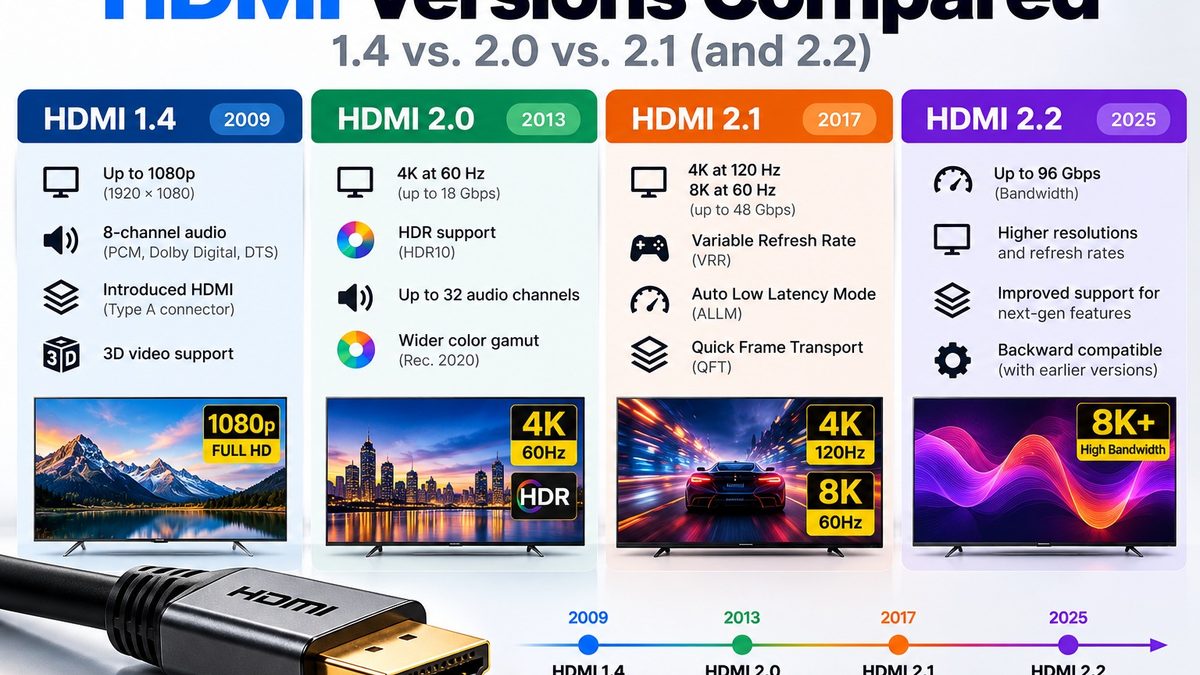
For a 4K TV with streaming and Blu-ray, HDMI 2.0 is enough; for 4K at 120 Hz gaming, variable refresh rate or 8K, you need HDMI 2.1. HDMI 1.4 handles 1080p and 4K at 30 Hz, HDMI 2.0 adds 4K at 60 Hz and HDR, and HDMI 2.1 raises the bandwidth from 18 to 48 Gbps and adds gaming and audio features. HDMI 2.2, the newest version, goes up to 96 Gbps, but you only need it if your devices advertise it. Every version works with older ones; the connection simply runs at what the weakest device supports.
HDMI versions at a glance
| Version | Released | Max bandwidth | Video | Key additions | Cable |
| HDMI 1.4 | 2009 | 10.2 Gbps | Up to 4K at 30 Hz | Audio Return Channel (ARC), HDMI Ethernet Channel (HEC), 3D, Micro connector | High Speed |
| HDMI 2.0 | 2013 | 18 Gbps | Up to 4K at 60 Hz | Wider BT.2020 color, up to 32 audio channels; HDR10 in 2.0a and HLG in 2.0b | Premium High Speed |
| HDMI 2.1 | 2017 | 48 Gbps | 4K at 120 Hz, 8K at 60 Hz, and up to 10K with compression | VRR, ALLM, QMS, QFT, DSC, dynamic HDR, eARC | Ultra High Speed |
| HDMI 2.2 | 2025 | 96 Gbps | Up to 12K at 120 Hz and 16K at 60 Hz | Latency Indication Protocol (LIP) | Ultra96 |
HDMI version timeline
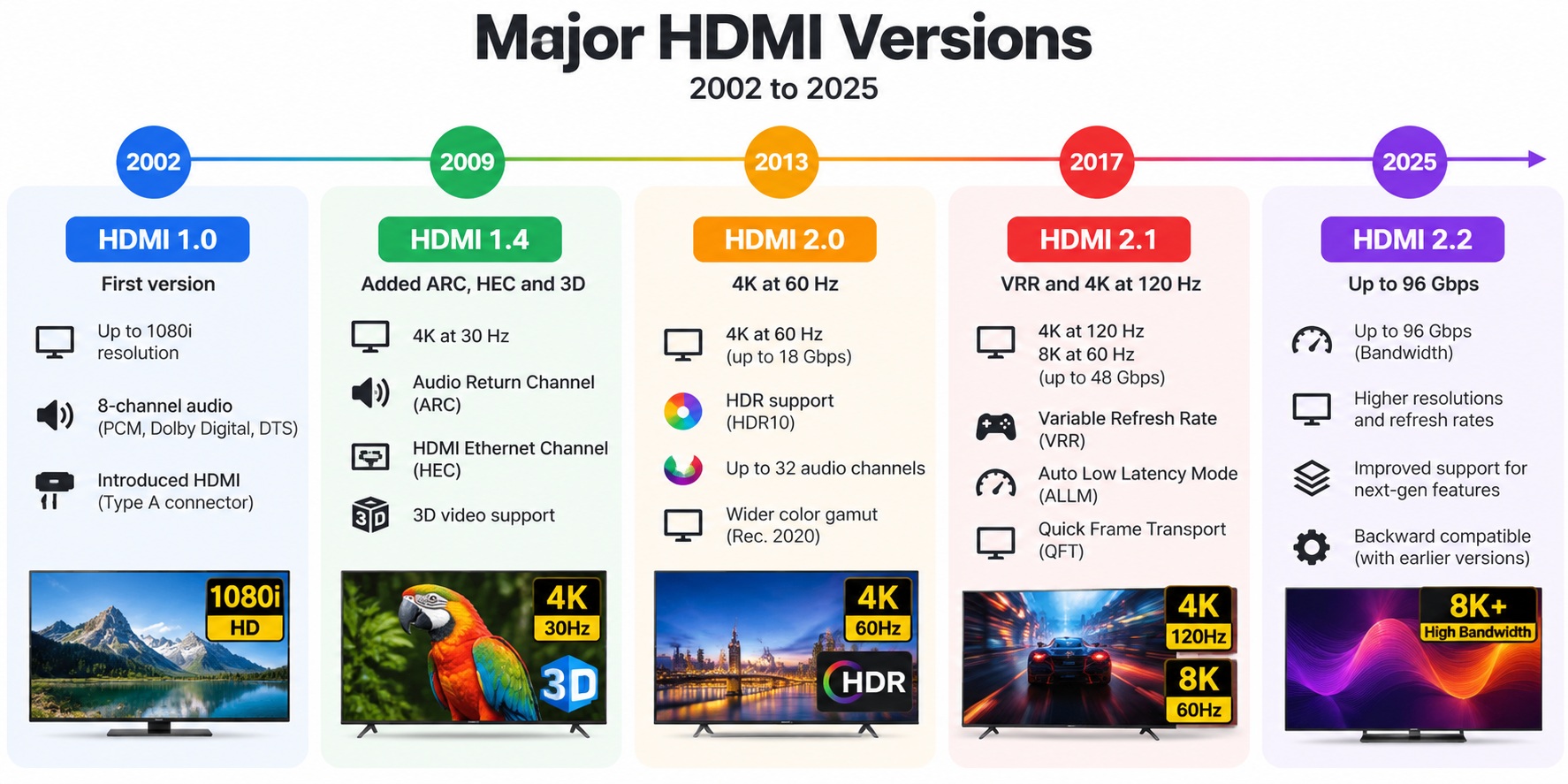
HDMI versions over time · 1.0, 1.4, 2.0, 2.1 and 2.2
Each step raised the bandwidth and added features; the points show the headline change of each version.
What did HDMI 1.4 add?
HDMI 1.4 was the first version to include the Audio Return Channel (ARC), which lets a TV send sound back to a soundbar over the same cable, and the HDMI Ethernet Channel (HEC), which lets two devices share a network connection. It also added 3D video and the first support for 4K resolution, but only at 30 Hz, at 10.2 Gbps. It introduced the Micro (Type D) connector and the Automotive Connection System as well.
HDMI 1.4 is still found on older TVs, projectors and monitors, and it is fine for 1080p video.
What did HDMI 2.0 add?
HDMI 2.0 raised bandwidth to 18 Gbps, which is what makes 4K at 60 Hz possible. It also added the wider BT.2020 color space, up to 32 audio channels, dual video streams for multiple viewers on one screen and the 21:9 aspect ratio.
Two sub-versions added HDR. HDMI 2.0a added HDR10, and HDMI 2.0b added support for HLG, the HDR format used for broadcast TV. For a TV used with streaming boxes, Blu-ray players and soundbars, HDMI 2.0 covers nearly everything.
What did HDMI 2.1 add?
HDMI 2.1 was announced in January 2017 and released that November. It increased bandwidth to 48 Gbps using a new signaling mode called Fixed Rate Link (FRL). That allows 4K at 120 Hz and 8K at 60 Hz, and with Display Stream Compression (DSC) even higher combinations, up to 10K at 120 Hz.
It also added features that matter mostly for gaming and home theater:
- Variable Refresh Rate (VRR): the display’s refresh rate follows the source’s frame rate, reducing tearing and stutter.
- Auto Low Latency Mode (ALLM): switches the display to its low-latency game mode automatically.
- Quick Media Switching (QMS): removes the blank screen when the source changes frame rate or resolution.
- Quick Frame Transport (QFT): sends each frame faster to reduce latency.
- Display Stream Compression (DSC): compresses the signal so very high resolutions and refresh rates fit.
- Dynamic HDR and eARC, the enhanced Audio Return Channel for lossless audio such as Dolby TrueHD and DTS:X.
A later update, HDMI 2.1a, added Source-Based Tone Mapping (SBTM). Our VRR, ALLM and QMS guide explains each gaming feature in detail.
What did HDMI 2.2 add?
HDMI 2.2 raises bandwidth to 96 Gbps, which supports resolutions up to 12K at 120 Hz and 16K at 60 Hz. It also adds the Latency Indication Protocol (LIP) for better audio and video synchronization across chained devices, such as a TV and an AV receiver. It uses a new cable, Ultra96, for the top speeds, and devices that carry the Ultra96 feature name need that cable to reach their full bandwidth.
Does the HDMI version number really matter?
Less than you might think. Two things make the number a poor guide:
- HDMI 2.1 features are optional. An HDMI 2.1 TV doesn’t need to support all of the 2.1 features. A port can be labeled HDMI 2.1 and still lack VRR, ALLM or eARC.
- Version labels have become unreliable. Reports say the HDMI Forum folded the HDMI 2.0 feature set into the 2.1 specification, so a device can carry a 2.1 label while offering only 2.0-level features.
So check the specification sheet for the exact features you want, such as 4K at 120 Hz, VRR or eARC, rather than relying on the version number alone.
Are HDMI versions backward compatible?
Yes. An HDMI 2.0 device on an HDMI 2.1 port works, but it is limited to HDMI 2.0 features and bandwidth. Likewise, an Ultra High Speed cable works with older devices, while an older cable works with newer devices only up to its own speed. The chain runs at the level of its weakest link.
Which HDMI version do you need for your setup?
- 1080p TV, streaming stick or older Blu-ray player: HDMI 1.4 is enough.
- 4K TV with streaming, 4K Blu-ray and HDR: HDMI 2.0 (with 2.0a or 2.0b for HDR).
- PlayStation 5, Xbox Series X or a gaming PC at 4K 120 Hz: HDMI 2.1, with VRR and ALLM if your display supports them.
- Lossless audio such as Dolby TrueHD or full Atmos through a soundbar: HDMI 2.1 with eARC on both devices.
- 8K video: HDMI 2.1.
- Devices that advertise the Ultra96 name: HDMI 2.2 and an Ultra96 cable.
Common questions
What is the difference between HDMI 2.0 and 2.1?
HDMI 2.1 raises the bandwidth from 18 Gbps to 48 Gbps and adds VRR, ALLM, QMS, QFT, DSC, dynamic HDR and eARC. That allows 4K at 120 Hz and 8K at 60 Hz, which HDMI 2.0 cannot do.
Can HDMI 2.0 do 4K 120 Hz?
No, not at full quality. HDMI 2.0’s 18 Gbps limit supports 4K at 60 Hz. 4K at 120 Hz needs HDMI 2.1.
Is HDMI 2.1 backward compatible with HDMI 2.0?
Yes. Devices and cables of different versions work together at the lower level.
Do I need a new cable for HDMI 2.1?
To use the full 48 Gbps, yes: you need an Ultra High Speed cable. For HDMI 2.0 features, a Premium High Speed cable is enough.
Does HDMI 1.4 support 4K?
Yes, but only at 30 Hz.
What is the latest HDMI version?
HDMI 2.2, released in 2025 with 96 Gbps of bandwidth.
Keep learning
- What Is HDMI? A Beginner’s Guide (CON-HDMI-001)
- HDMI Cable Types (CON-HDMI-003)
- HDMI 2.1 Bandwidth and Supported Resolutions (CON-HDMI-010)
- How ARC and eARC Work (CON-HDMI-011)
- VRR, ALLM and QMS in HDMI 2.1 Explained (CON-HDMI-016)
1 comment